Work instructions
How to make good assembly line work instructions
· Updated · 6 min read
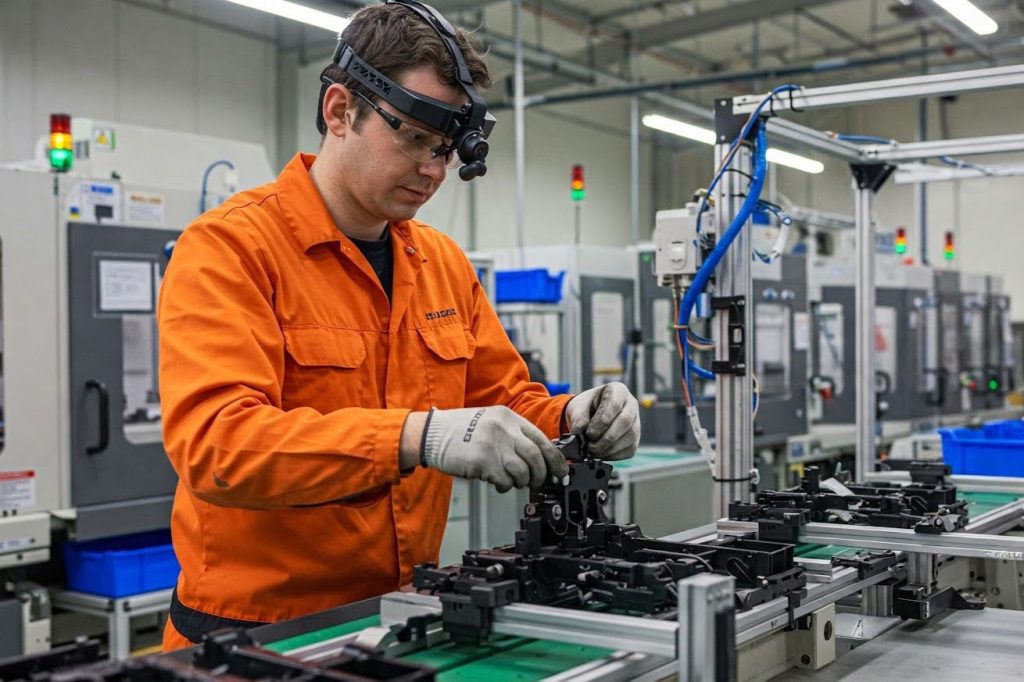
Every employee has a slightly different way of doing things. Each has a different background, different experience, different depth of skill, and a slightly different work process—and that introduces variation into a company's workflow. The larger your operation, the more variation works its way into the production line. Work instructions are key to reducing variation, allowing manufacturers to improve quality and meet demand. Good assembly line work instructions are also a strong training tool for new employees.
On many lines today, the people doing the work don't all share a first language or a background. Instructions that lean on dense text or verbal explanations often don't carry the original intent to everyone, and the gap shows up as errors and rework.
Are your work instructions worthless?
Let's first touch on what good work instructions are not. Check the list below to see if any of these items apply to you:
- They are written over the head of the operator, who would have a hard time referring to them if needed.
- Work instructions are prepared for ISO 9001 auditors and for customers, with the assumption that nobody looks carefully at whether they work on the line.
- There are no images or photos. With text only, it takes more work to check that they match the product being made. As a result, instructions are not engaging and operators don't read them.
- Group leaders and supervisors know the instructions are meaningless, so they don't use them as a standard. Ideally they would check periodically whether an operator follows the applicable standard.
- Important quality considerations are not followed – for example checking 1 in 10 pieces for dimensional conformity.
- Important safety considerations are not followed – for example keeping hands in defined positions so they are never caught in a stamping machine.
- Important maintenance considerations are not followed – for example opening a compartment and cleaning the equipment.
How to create great work instructions for your assembly line
If your New Product Introduction (NPI) engineers haven't prepared a standard work instruction sheet already, you'll need to start writing them up. Follow the principles below to make your instructions easy to follow.
Standardise the work on assembly lines (and elsewhere)
The core idea behind assembly line instructions is to follow "the one best way currently known in this organisation", so that if five people work on a particular job, they do it the same way. If every operator has their own process, improving the way they work becomes quite difficult. With a shared standard, one improvement to the work instructions can be applied immediately across the board and improve productivity, quality and safety.
Write it with the people who do the work every day
The people on the assembly line day in and day out often know how to do the job better than engineers sitting in the office. Why not pull them out of production for an hour and work together to define the best way to do it? It gives you better insight into the process, and it trains them to think about it too. They may come back a week later with a better idea. Involve the line or group leaders as well. Over time, the whole team learns to solve problems.
Ask the most experienced person on the task to walk you through it. That is what makes an instruction credible to the people who will use it.
Get employee buy-in
Some factories treat their operators as disposable. They tell them what to do, provide little training, and hope to replace them with automation. Don't fall into that trap. Involving workers when you write work instructions leads to lasting improvement because you get their buy-in. Even if they disagree with part of it, they have had the chance to give their opinion and discuss it with their team. That usually means less resistance later.
Visualise standard work instructions
Once work instructions are written, they need to be followed. A leader or supervisor should be able to walk the line and see at a glance whether the standard is being followed. Photos, drawings and short video clips show an assembly step much better than paragraphs of text. We have seen many work instruction sheets written on bland templates with no graphic element to show the process, and unsurprisingly, nobody reads them.
Keep them clear, short and consistent
- Clear – no room for interpretation. If a step can be read two ways, someone will read it the wrong way.
- Short – one action per step, plain words, no jargon the operator wouldn't use.
- Consistent – the same structure, terms and symbols across every instruction, so operators know where to look.
- Accessible – available at the station, at the moment the operator needs it, not in an office binder.
Include other elements in assembly line work instructions
When people think of standard work instructions, they think of a work sequence – first do this, next do that. That is useful, especially if it also covers material movement, inspection and testing. But your instructions can include more. Add a standard time for each process, so the line stays balanced. This shouldn't be used to penalise workers or single out the slow ones. It shows where the line is out of balance and who needs more training.
Train your process engineers
Do you want to develop your junior engineers? Give them projects to improve productivity based on the work instructions and the data they gather. A standard work combination table is useful when you want to go into detail: it shows manual time, automatic machine time, walking time and waiting time for one operator against the takt time.
Conclusion
Good assembly line work instructions describe one agreed way of doing the job, are written with the people who do it, and show each step visually. Keep them short, put them at the station, and update them whenever the line finds a better way. Instructions that operators actually use are the basis for consistent quality, faster training and any improvement you want to make stick. If your lines run many variants, see work instructions for high-mix assembly.
Where REWO fits
REWO Guides turn video, images and text into step-by-step instructions that open at the workstation by QR code or from your MES. Changes go through approval and version history, so every station shows the current version.
Read next: Work instructions for high-mix assembly · REWO Guides · The complete guide to work instructions in manufacturing