Training & skills
Onboarding agency and foreign workers when you don't share a language
· 5 min read

It's Monday morning. The agency has sent twelve people for the new shift. Five speak Ukrainian, four speak Nepali, three speak some English, and none of them speak the language your instructions are written in. The line starts at six.
For a growing number of plants in Central Europe, this is a normal Monday. Yet the onboarding methods most plants rely on were built for a stable workforce that shares a language with its trainers.
Why shadowing breaks first
Most plants onboard by shadowing: an experienced operator shows the new person the job until they can do it alone. It works when both speak the same language and the mentor has time. With a multilingual intake, three things go wrong at once.
- The explanation doesn't land. A mentor explaining in the local language — and the new hire nodding — is not the same as understanding. At Aluflexpack, verbal instruction in Croatian often didn't land with international employees.
- Every mentor teaches it differently. Shadowing passes on each mentor's version of the job, including their shortcuts.
- Your best people stop producing. Every hour your strongest operator spends repeating the same explanation is an hour their machine isn't running.
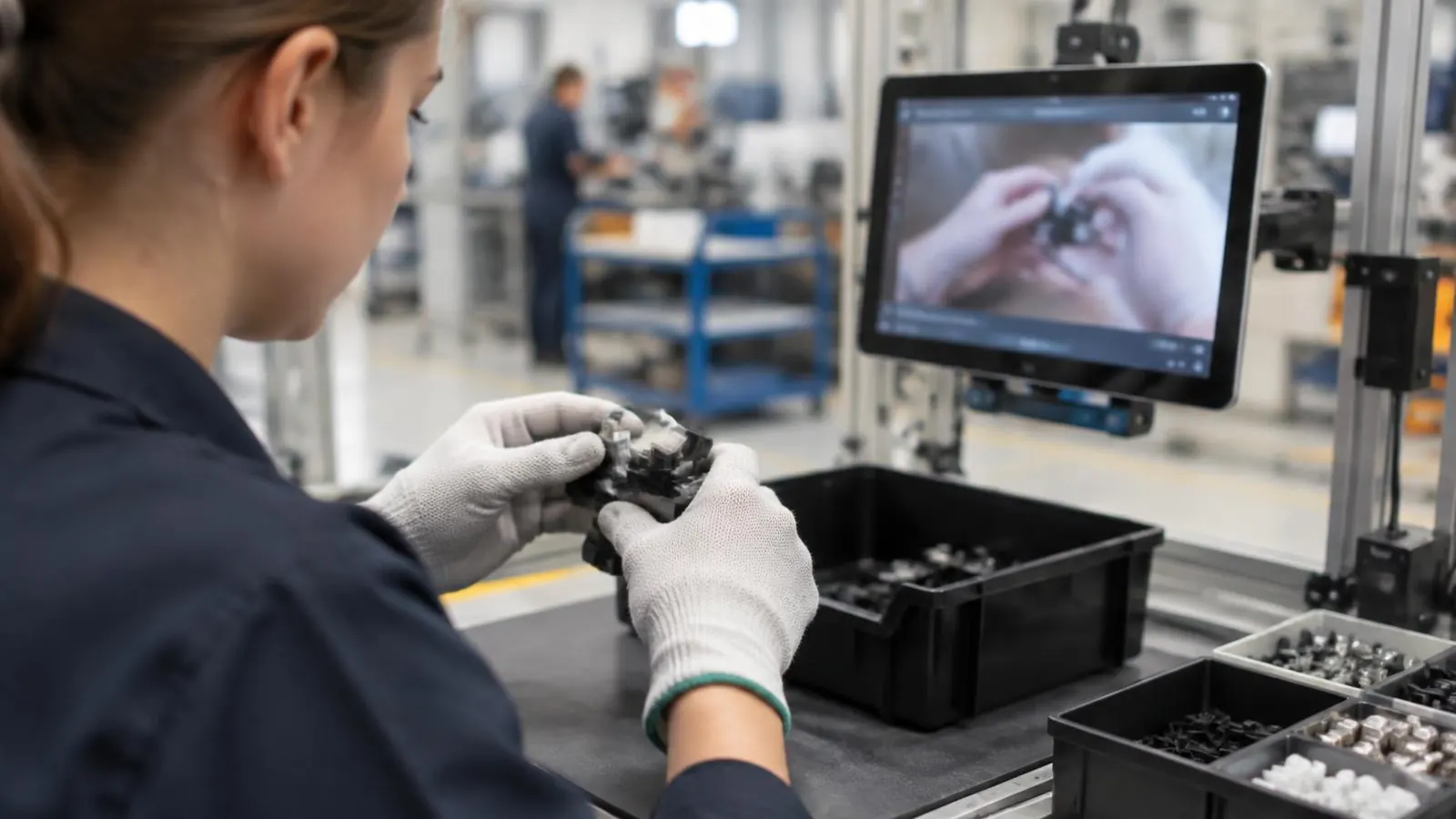
Aluflexpack moved from shadowing to video instructions on tablets. New operators on basic machinery now train in five days instead of two to three weeks, without stopping production for training sessions.
What works instead
1. Show it on video
Video carries most of the meaning without language: where the hands go, which part goes first, what "correctly seated" looks like. Keep the text layer short — one action per step, one sentence per action. A clip of the correct result next to a photo of a common mistake does more than a paragraph.
2. Translate the words that remain — and review them
Machine translation is now good enough to produce a usable first draft in minutes, in almost any language. It is not good enough to be trusted unchecked on safety and quality steps. Use it to get the draft, then have a bilingual colleague or the agency's coordinator review the critical steps. Keep a short glossary of part names and tool names, so "clamp", "fixture" and "jig" don't become three different words in Ukrainian.
Write the source text so it translates well: short sentences, no idioms, no abbreviations only your plant uses, units and numbers written out the same way every time.
3. Let the operator choose the language
The instruction at the station should open in the operator's language, not the plant's. If an operator has to ask a colleague to translate the screen, you're back to shadowing.
4. Split the first days into layers
Don't try to teach everything at once. Safety and site rules first, then one station, then the quality-critical points of that station, then the next station. Each layer is a short guide or a group of guides, not a slide deck.
5. Check understanding in their language
A signature on a form the person couldn't read proves nothing. A few questions with pictures — "which of these is correctly assembled?", "what do you do if the part is scratched?" — in the operator's own language show whether the instruction landed. Keep it short: three to five questions per critical step.
6. Keep the mentor for the last step
Video and assessments take the repetition off your experienced people. They don't replace the moment someone watches the new hire do the job on the real line and says "yes, you can work alone now". Keep that sign-off, and keep a record of it alongside the training record.
7. Treat agency staff like everyone else in the record
In automotive, IATF 16949 explicitly extends on-the-job training requirements to contract and agency personnel. Even outside automotive, an auditor or customer will ask who was on the line and how they were trained. Agency workers belong in the same training record as employees, on the same instruction revisions.
A five-day structure
This is a starting point, not a standard. Adjust it to the complexity of your stations.
- Day 1 — Site and safety. Plant rules, PPE, emergency routes, the safety rules for the area. Short guides in the operator's language, a short assessment at the end.
- Day 2 — First station, watched. The station guide on a tablet or screen at the workstation. The new hire follows the guide step by step while an experienced operator watches. The guide carries the method; the operator only supervises.
- Day 3 — First station, alone with support. The operator runs the station using the guide; the line leader checks in. Quality-critical steps get their own short assessment.
- Day 4 — Quality and what to do when something's wrong. Defects, what to do with a suspect part, who to call. Second station if the role needs it.
- Day 5 — Sign-off. Final assessment, then the mentor's practical sign-off on the line, recorded the way you record it today. The training record shows which instructions, which revisions and which results.
When a guide changes later, make sure the people trained on it see the new version and, for critical steps, retake the short check.
Where REWO fits
REWO turns your experts' know-how into visual, step-by-step guides that operators open at the station, in their own language — translation into 100+ languages, reviewed by your team before release. Courses combine guides and Forms assessments into an onboarding path with pass criteria and certificates, and every view, result and confirmation sits in one record per person — employees and agency staff alike.
Read next: Courses · For operators · How AI translation keeps meaning · Aluflexpack case study