Quality & compliance
IATF 16949 at the workstation: what auditors check on your work instructions
· 6 min read
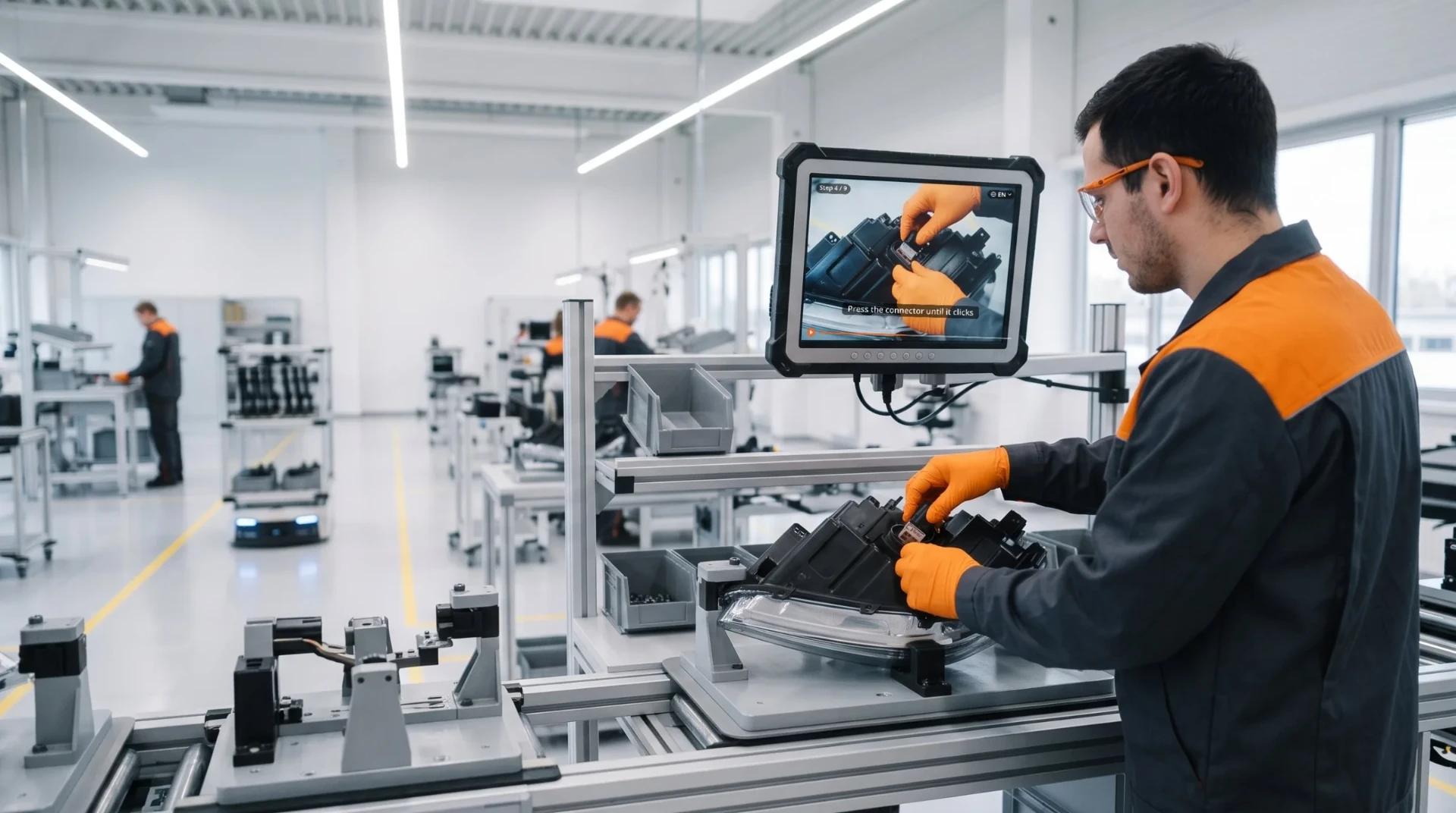
Most automotive suppliers have a document control procedure that would survive any desk review. Revisions are numbered, approvals are signed, the master list is up to date. Then the auditor leaves the meeting room, walks to a station on the second shift, and asks the operator to show the instruction for the job in front of them.
That is where IATF 16949 findings on work instructions often come from: the gap between the procedure and the workstation.
What the standard asks for at the workstation
Three parts of IATF 16949 (on top of ISO 9001) meet at the workstation.
Standardised work (8.5.1.2). Standardised work documents — operator instructions and visual standards — have to be communicated to and understood by the people doing the work, legible, presented in the language(s) those people understand, and accessible at the designated work area. They also have to include rules for operator safety.
On-the-job training (7.2.2). Anyone taking on new or modified responsibilities that affect conformity to quality requirements gets on-the-job training, and this explicitly includes contract and agency personnel. The depth of training should match the person's education and the complexity of the task, and people whose work can affect quality have to be told the consequences of nonconformity to customer requirements.
Control of documented information (ISO 9001 7.5.3). Documents have to be available and suitable for use where and when they're needed, and changes have to be controlled — which in practice means the operator must be working from the current revision, not the one that was printed last spring.
None of this is new. What makes it hard is that every one of these requirements is about what happens at the station, on every shift, for every person — including the agency worker who started on Monday.
(Clause summaries are paraphrased. Check the exact wording against your copy of the standard and your customer-specific requirements.)
The questions you'll hear on the floor
Auditors vary, but the station-side questions follow a pattern. Each one tests a different requirement.

- "Show me the instruction for what you're doing now." Is it accessible at the work area, and can the operator find it without help?
- "Is this the current revision? How do you know?" Does the copy at the station match the released version? Is there any way an old binder page could still be in use?
- "Can you read this?" Is the instruction in a language the operator understands — and if it was translated, was the translation updated when the source changed?
- "Who trained you on this, and when?" Is there a record that links this person to this task, before they started doing it?
- "What happens if this characteristic is out of specification?" Does the operator know the consequence for the customer — not just the step?
- "This instruction changed last month. Who has seen the change?" Can you show which operators were informed of the new revision, and which weren't yet?
Questions 4 and 6 are the ones that hurt. A signed training matrix from the onboarding week doesn't answer "who has seen last month's change", and a signature sheet at the station doesn't prove the person who signed understood what changed.
Where paper and shared-drive systems break
The failure modes are familiar to anyone who has prepared for a surveillance audit:
- Revision drift. A change is released in the document system, but the binder at station 14 still holds the previous page. Nobody notices until someone pulls it out in front of an auditor.
- Translations lag behind. The German or Slovenian master is updated; the Ukrainian or Nepali version used by half of the night shift is not.
- Training records live somewhere else. HR holds the onboarding sign-off, the line leader holds a spreadsheet, and the link between this revision and this person exists only in someone's memory.
- Agency staff fall through the gap. They're on the line, they're covered by 7.2.2, but they often don't appear in the same records as employees.
- Safety rules sit in a separate document. 8.5.1.2 expects them in the standardised work documents. In some plants they are on a poster at the hall entrance.
What good evidence looks like
You don't need more paperwork to answer the floor questions. You need one connected record:
- One released version per instruction, with approval and change history, and nothing else reachable at the station.
- Point-of-use access — a QR code at the station or the instruction opened from the MES with the work order — so the operator never has to search.
- Translations reviewed and re-released with every change to the master, so no language version lags behind.
- A record per person and revision: who opened the instruction, who confirmed it, and when. Employees and agency staff in the same record.
- A short check of understanding for critical or changed steps — a few questions in the operator's language — rather than a signature alone.
- Requalification when a certificate is due for renewal, and a fresh check of understanding when a critical step changes.
With that in place, question 6 becomes a filter: revision 7 of this instruction, released on this date, seen and confirmed by these people, outstanding for these.
A pre-audit check you can run this week
Pick three stations, including one on a night or weekend shift, and check:
- Can an operator open the current instruction in under a minute, without asking anyone?
- Does the revision at the station match the released revision in your document system?
- Is every language version at the station on the same revision as the master?
- Do the instructions include the operator safety rules for that station?
- For the last change to each instruction, can you list who has been informed — and who hasn't?
- Can you show training records for an agency worker currently on that line?
- Can the operator explain what a defect at their station would mean for the customer?
If any answer is "we'd need a day to find that", that's where the finding will be.
Where REWO fits
REWO closes this gap. Instructions are created as visual, step-by-step guides with a two-step approval and full version history, translated into the languages your operators read, and delivered at the station by QR code or inside your MES. Every view and confirmation is recorded against the person and the revision, and short assessments built with Forms check understanding after a change.
At VHIT, printed instructions were replaced by a document layer inside the MES: approved updates reach every shift immediately, and each review is recorded against the operator's badge. Hidria runs its standard work on video, opened from MES terminals.
One boundary matters for auditors: REWO records how instructions were communicated, checked and signed for. Whether the torque was right stays in your MES and process controls.
Read next: REWO for automotive suppliers · For quality and compliance teams · The Analytics record