Lean & standard work
One standard, several plants: rolling out work instructions across a manufacturing group
· 4 min read
Ask a group operations director how many ways their plants do the same job and the answer is usually "one per plant, sometimes one per shift". The product is the same, often the machines are the same, but the method drifted the day each plant started training its own people.
That drift costs money in ways that are hard to see from headquarters: different scrap rates on the same part, a line transfer that takes months longer than planned, a customer audit at one plant that finds what the other plants would have caught.
Why plants drift apart
Nobody decides to run five versions of a process. It happens because:
- Each plant writes its own instructions, usually in its own language, often by copying and adapting another plant's document once and never syncing again.
- Improvements stay local. A better method found on the night shift in one plant never reaches the others.
- Headquarters can't read what the plants wrote, and the plants can't read what headquarters wrote. The standard exists in German; the instructions on the line are in Polish, Czech or Hungarian, and nobody can check one against the other.
- There's no shared record. Each plant can say who was trained on what — in its own system. Nobody can answer the question for the group.
At MANN+HUMMEL, the starting point was exactly this: across plants and shifts, the same work was being learned and done in different ways. Using video instructions for training, changeovers and everyday reference at the workstation, they reduced changeover inefficiency by 15% and cut training time on certain skills by up to 50%.
Decide what is global and what is local
A common mistake is trying to make every plant identical. Equipment differs, layouts differ, local regulations differ. A useful split:
Global — owned centrally, the same everywhere:
- The method for quality-critical and safety-critical steps
- Quality characteristics and what to do when they're out of specification
- Safety rules for the operation
- The structure and look of instructions, so an operator moving between plants recognises them
Local — owned by the plant, traceable to the global standard:
- Language
- Equipment-specific steps where machines genuinely differ
- Layout, material flow and station references
- Local regulatory additions
The rule that makes this work: every local version keeps a clear reference to the global standard it comes from, and every local version is reviewed when the standard changes — instead of at the next audit.

Governance that doesn't slow everyone down
A group standard only survives if changing it is easier than working around it.
- One owner per standard, usually a process or industrial engineer at the lead plant or at group level.
- A defined approval path — author, reviewer, release — the same in every plant, so a released instruction means the same thing everywhere.
- A way for plants to propose improvements, so the best local method becomes the next global version instead of a local exception.
- Translations reviewed locally before release.
- A review rhythm tied to use and to change — not a calendar reminder nobody acts on.
Start with one plant and one process
Group rollouts fail when they start with "all plants, all processes". They work when they start small and visible:
- Pick one process that hurts — a frequent changeover, a training-heavy station, a product moving between plants.
- Build the standard at one plant, with the operators who do the job, and prove it there: training time, changeover time, defects, audit readiness.
- Turn what worked into the template — structure, approval path, naming, translation workflow.
- Roll it to the next plant on the same process, with local adaptation, before widening the scope.
Line transfers: the stress test
Nothing tests a group standard like moving a line from one plant to another. Everything the source plant knows but never wrote down has to arrive in a different place, often in a different language, usually against a deadline.
Instructions captured in the source plant — on video, by the people who run the line — become the training material at the receiving plant. Coloplast used the same REWO instructions that run in its MES to support a production-line transfer to Costa Rica. For the knowledge side of a move, see relocation of production lines.
What to measure at group level
- Coverage: which stations in which plants work from the group standard, and which still run on local documents.
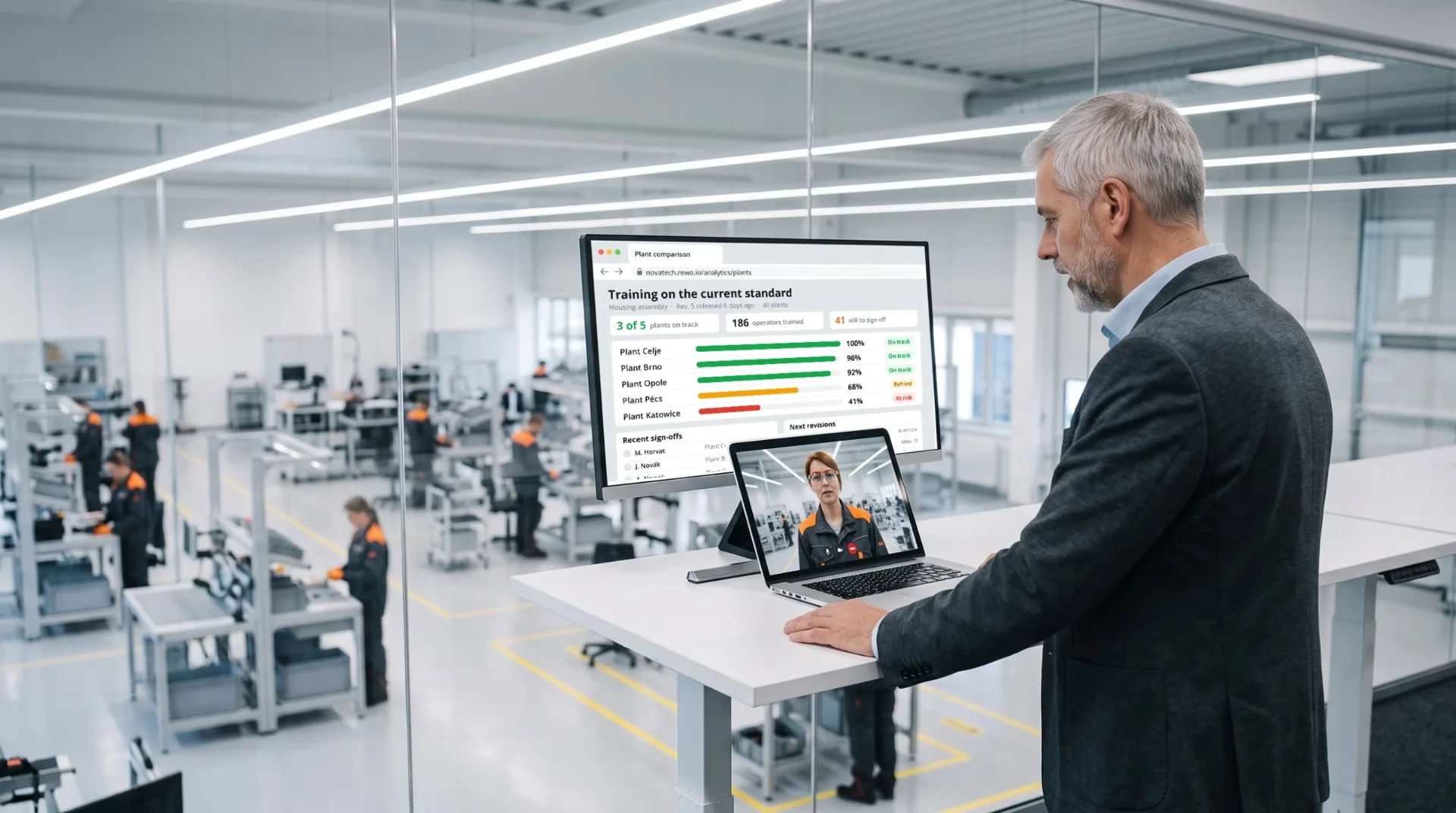
- Currency: for each standard, which plants are on the current revision.
- Training: who in each plant has been trained on the current version — one view across plants, not five spreadsheets.
- Outcome: the operational number you chose at the start — training time, changeover time, scrap — compared across plants.
Where REWO fits
REWO gives a group one place for its work instructions: shared standards alongside each plant's own content, the same two-step approval in every plant, translation into each plant's languages, and delivery at the station by QR code or inside the MES. Group operations sees across all plants — who has seen and confirmed which revision, plant by plant.
Read next: For group and multi-site operations · MANN+HUMMEL case study · The Analytics record